Roast #45: Our roasting style
I preface that nothing below has any scientific basis. These are just patterns that I've witnessed from roasting with the Diedrich IR-5 machine.
Most of these realizations are relative to 1.5 years ago, when we first started roasting on the IR-5.
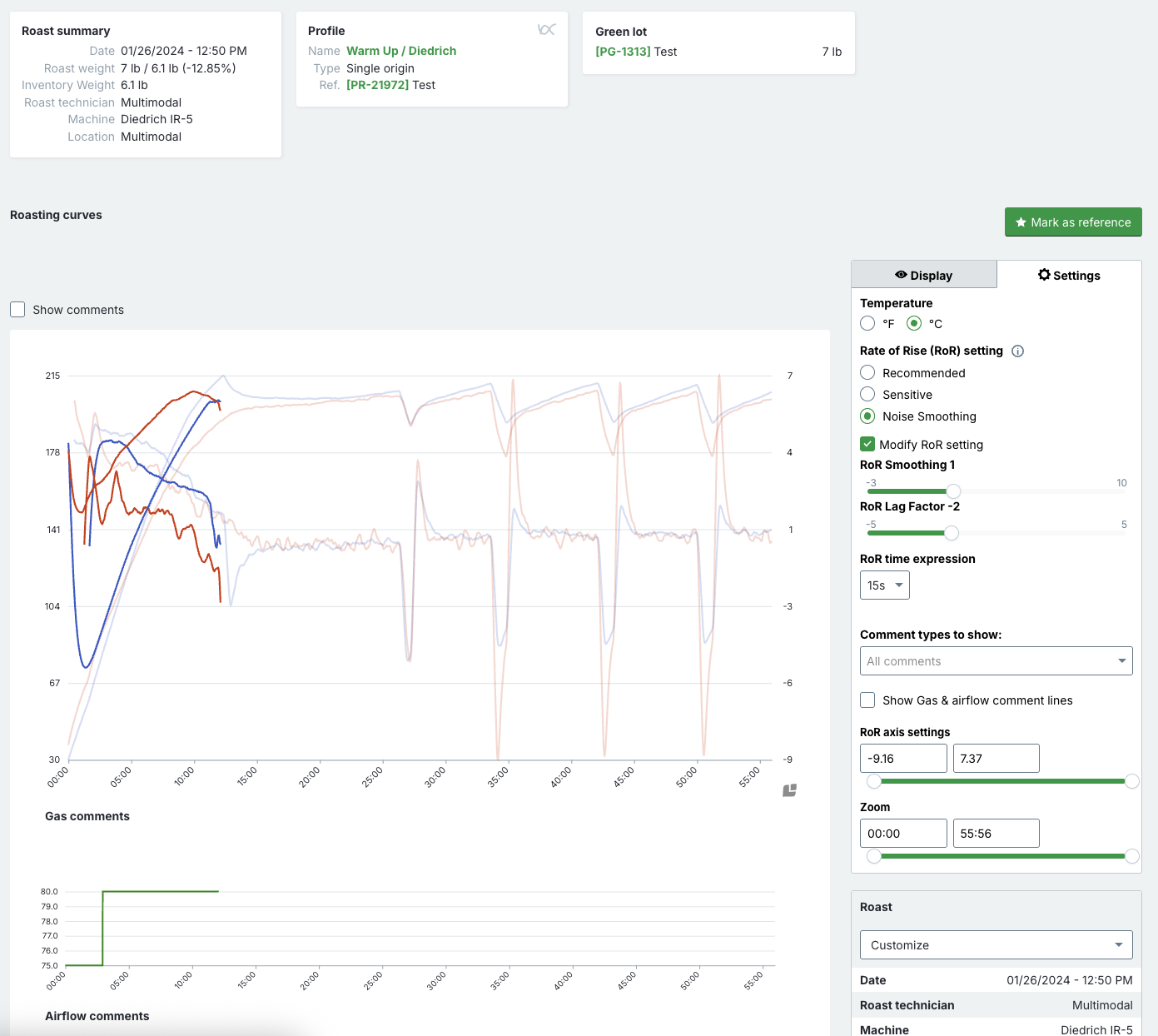
Our first ever roast on the IR-5 — what a beautiful curve. I didn't know how to end the roast or properly log roast data 🥲
The machine:
It's helpful first to understand the characteristics of the machine we use for roasting. We roast on the Diedrich IR-5, which is a drum/gas roaster. The one we work with (at Multimodal) is pretty manual (manual data logging, no roast playback).
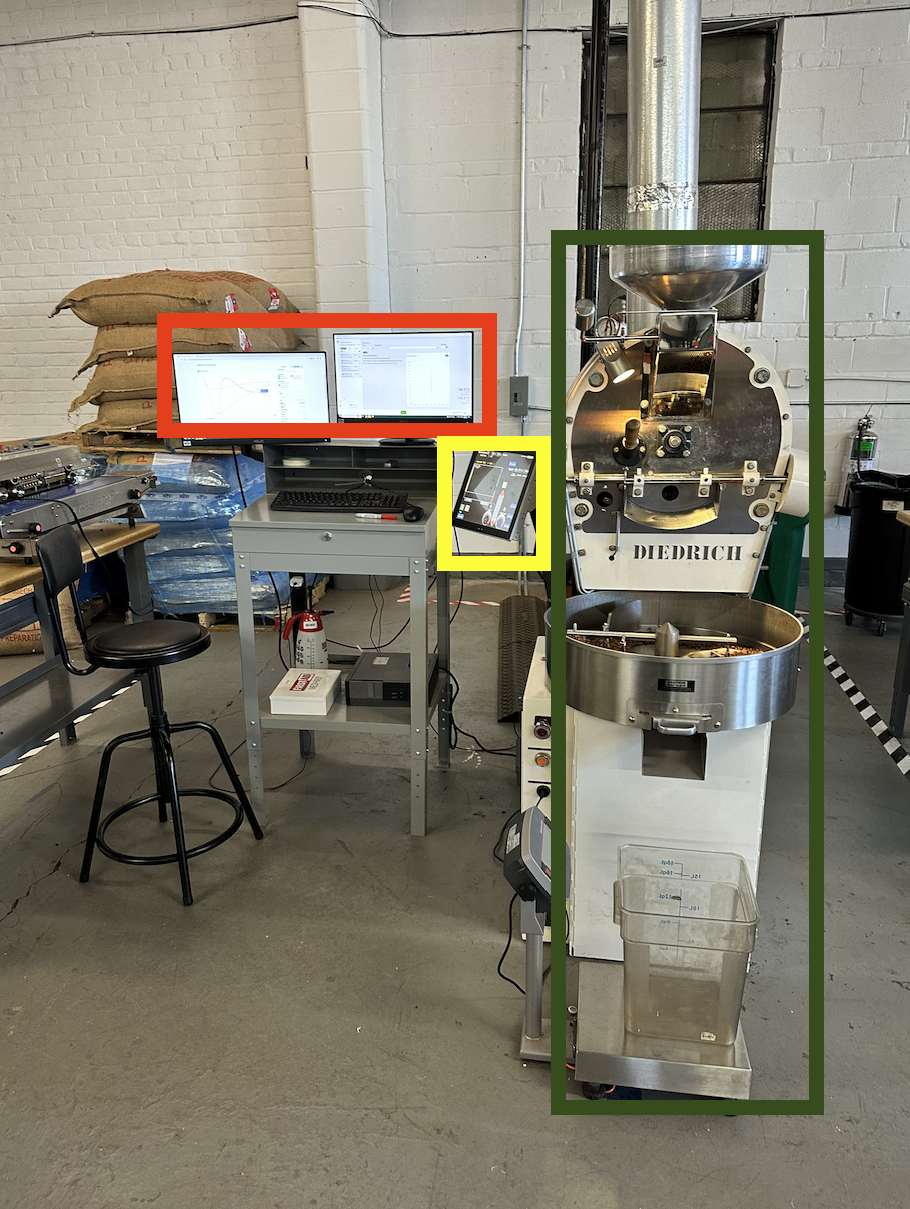
red is cropster (roasting software), yellow is the roasting panel touch screen to apply adjustments, and green is the roaster. the flow is make changes on yellow, record on red, and periodically look into the tryer for green
Being so manual results in some variance with each roast, as it's up to the user to trigger the adjustment. The plus side of this is that I feel I've developed intuition and understanding of how the beans should behave.
The variables we can adjust are power (0-100) and fan speed (0, 50, 100). I wouldn't mind having more variables to adjust and increments to work with. :)
Between Batch Protocol (BBP)
BBP was something I didn't pay much attention to when I first started. However, the more I roasted, the more I realized that you need a strategy that is long enough to stabilize and reset the machine between roasts, while also being short enough to avoid consuming too much of your paid roast rental time.
I realized this was an issue when, after one roast, we walked away to have a conversation with a friend. Then we came back, brought the machine up to charge temp, and noticed the roast progressing at a way slower rate. We baked the batch and had to toss it.
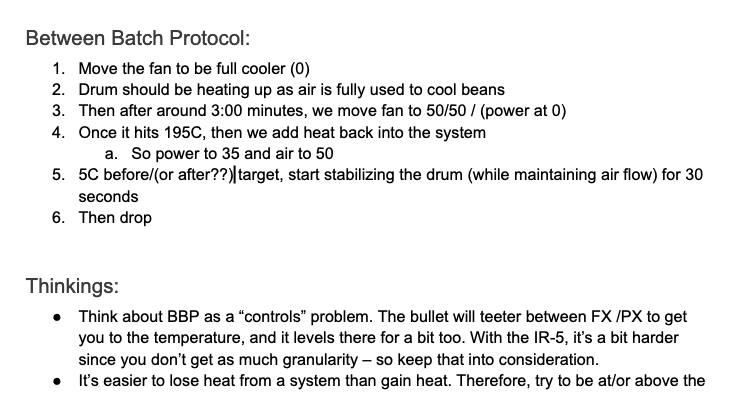
our current BBP procedure
We then developed a step-by-step procedure. This procedure reset and stabilized the drum, but when it came to roasting volume, we found ourselves consistently needing to book more time. We analyzed our sessions and noticed that we were sometimes only running 2 roasts per hour. This low roasting count suggested that our BBP might be too long. We are now at a BBP of around 6-7 minutes.
Ideally, we should be around 8:30 minute roast + 6:30 minutes BBP, with a total of 15 minute per roast run. So if the timings all go right, we should have an output of 4 roast runs (60 minutes / 15 minutes per roast run).
We don't have any immediate plans to change our BBP currently. To save time, we think the next step might be to move to a larger machine (likely not for a while though).
We need to collect more data about the greens
We haven't started doing this yet, but we will soon.
The need for this arose from roasting the Finca Bet-el Pink Bourbon in Coffee Club V11. The coffee club members know the details, but in short, the post-roast readings for this coffee didn't behave as I expected, and I ended up deducing that it needed more development (which ended up being wrong).
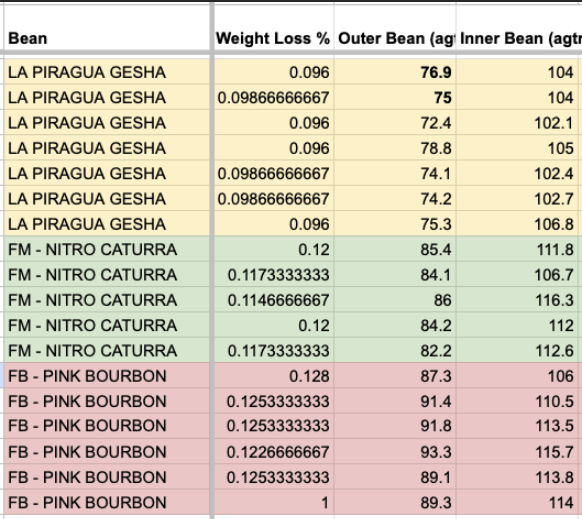
agtron numbers and weight loss for the PB confused me. most weight loss, but lightest agtron readings
Anyway, I think we could've caught this issue had we gathered moisture data from the start. My current thinking is that this bean had a higher moisture content, which resulted in higher weight loss readings while maintaining light roast color readings.
So the heat was being spent on evaporating moisture rather than caramelizing the surface of the bean and affecting agtron readings. I don't know — I'm out of greens for this one, so can't confirm. :(
Lower drop temps
We've been experimenting with lower drop temperatures. We used to have a fairly stringent requirement of finishing at 199°C+. We have mainly abided by this rule to prevent underdevelopment.
However, we've been roasting more competition-grade coffees lately, and we are noticing that they tend to hit first crack really early (ie 185C vs 190C). This is likely related to the water composition of these beans (another reason to measure green data). Cupping these lower-temp roasts were quite nice. We felt the cup still had depth, and the acidity characteristics were sometimes brighter than a higher drop-temp roast.
This is something we are still testing and playing around with.
Always soak:
We used to test profiles without a soak. We now always apply a soak.
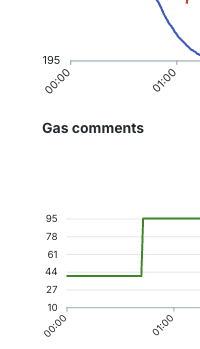
low heat to start, then ramp up gas
With a soak, we feel we remove the beginning of the roast as a spot where roasty qualities can form. Sometimes if the drum is too hot, the initial contact of the greens with the heated surface could result in scorching. This can still happen if the drum isn't stabilized through BBP or if the charge temp is too high though.
We are much more okay with developed coffees now
We are more open to developed coffees than before. I used to think any development was bad, and that we should aim to roast the coffee just a teeny tiny touch. Note that our coffees never really turned out this way, but at least that was the goal 🥲.
There was one coffee that kind of helped change our minds on this. We roasted it pretty light, and the resulting cup was good. It had structure and expressed nice acidity.

we usually are around 9% to 11%. weight loss. 14.7% is a lot for us
However, I accidentally ran a batch a bit darker, and the difference in the cup was quite noticeable. The darker roast elongated the brew and provided depth to better highlight the acidity. The acidity felt sharper, and I felt the resulting cup was way more complex.
The difference in weight loss was 4%.
This bean was pretty delicate in its profile to start. It wasn't heavy funk, nor did it have heavy process, so maybe extra development has a good place with more delicate coffees.
It doesn't have to be perfect
When I first started out, any minor mistake or any minor taste difference, I'd consider throwing it out. I expected that each batch should taste exactly the same as the prior one.
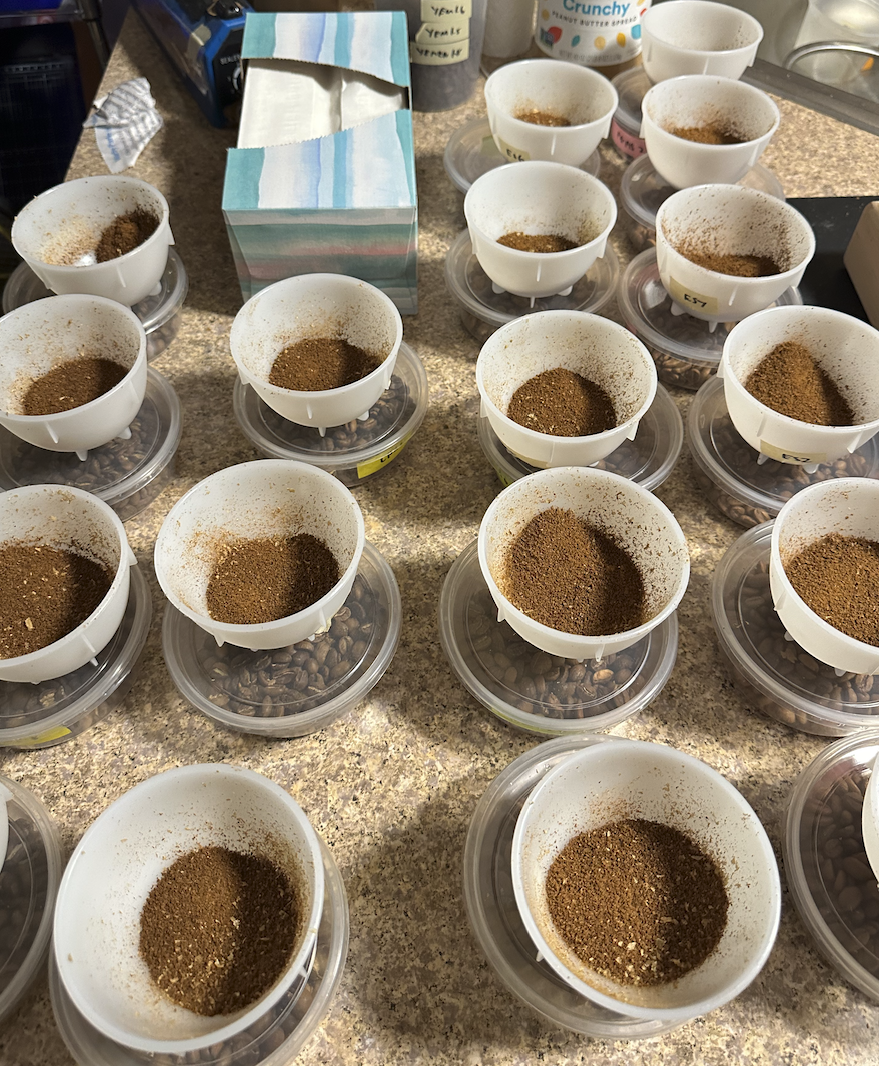
cupping/qc-ing roasts
Because of this mindset, I tossed a lot of coffees that likely didn't need to be tossed.
I don't think like this anymore. When we do our post-roast quality control cupping, we mainly test for defects. We do still test that the intended profile is expressed, but we don't test that all cups have equal juicy/acidity/aroma characteristics.
I can't compare a roast against a prior roast. There are too many variables (the quality of greens for that batch, the flow of natural gas that day, the environment of the roastery that day, etc.) that could differ and result in non-equal roasts.
—
Thanks for reading.